
Less is more for health and happiness

  • Home
  • Immune & Health
  • Diagnosis & Treatment
  • Heart & Soul
  • …  
    • Home
    • Immune & Health
    • Diagnosis & Treatment
    • Heart & Soul

Less is more for health and happiness

  • Home
  • Immune & Health
  • Diagnosis & Treatment
  • Heart & Soul
  • …  
    • Home
    • Immune & Health
    • Diagnosis & Treatment
    • Heart & Soul

The novel Journey to the West Episode 1: The Birth of the Stone Monkey & The Awakening of the CD8⁺ T Cell — The Growth of an Immune "Killer"

· science,art,diagnostics,treatment

The novel Journey to the West (Immunology Version)

On the Mountain of Flowers and Fruit in the Eastern Continent of Superior Body, the clouds and mist looked like a fairyland. At the mountain's peak stood a magic stone that had absorbed the essence of the sun and moon for thousands of years, glowing faintly with golden light like a fully charged battery. Suddenly, with a deafening thunderclap, the stone exploded. A streak of golden light shot into the sky. When the light faded, a stone monkey with a hairy, thunder-god-like face was left scratching his head, looking at the world in total confusion, much like a newborn baby waking up with no idea where he was.

"Where is this place? Who am I?" The stone monkey skipped and leaped through the woods, grabbing wild fruits one moment and chasing wild hares the next. Seeing that this little guy had innate divine strength, jumping higher and lifting heavier than anyone else, the other apes gathered around, calling him "Great King" and directly pushing him onto the throne as the lord of the Mountain of Flowers and Fruit.

As days passed, the stone monkey lived a carefree and comfortable life on the mountain, eating, drinking, and playing around. But the joy didn't last long before worries set in. One day, watching an old ape die of old age, he squatted on the ground, hung his head, and sighed: "We live so happily every day, but in the end, we still can't escape life and death. Is there no way to live forever?"

A wrinkled old ape leaned in and whispered, "Your Majesty, I've heard there are fairy mountains across the sea where immortals live. Maybe they can teach you the art of immortality, so you'll never have to fear death again." The stone monkey's eyes immediately lit up. He slapped his thigh and decided: "Great! I'll cross the ocean right now to find the immortals and learn their skills!"

Acting immediately, the stone monkey stuffed a few wild fruits into his pockets, hopped onto a wooden raft, and drifted out to sea. Along the way, he endured wind, sun, waves, and rain, nearly ending up as a shark's snack. Finally, he drifted to the Spirit Platform Heart Mountain and met the Patriarch Subhuti. The Patriarch sat perfectly on a lotus throne, his eyes piercing and bright—clearly no ordinary person.

"You stone monkey, you have some spiritual roots. What path do you seek?" Patriarch Subhuti asked slowly, stroking his beard. The stone monkey dropped to his knees with a thud and said respectfully, "Your disciple wishes to learn the art of immortality to escape the cycle of life and death. Please guide me, Patriarch!"

Subhuti smiled and waved his hand. "The immortality you seek isn't about your physical body never dying; it's about becoming the guardian of the 'Great Tang Empire' (our human body). Only by protecting the peace of the body can you achieve true immortality. I will teach you the 72 Transformations, so you can identify 'bad guys' (antigens) and adapt flexibly. I'll also teach you a set of 'killer moves' to help you shed your ignorance and become a true immune 'killer'."

The stone monkey scratched his head, still not quite understanding. "Patriarch, what are 'bad guys'? And what's a guardian?"

"The 'bad guys' are the demons and monsters invading the 'Great Tang Empire'—they bully the common people (body cells) and cause destruction. And you must drive these 'bad guys' out to protect the safety of the people," Subhuti paused, his tone growing serious. "However, your temper is too impulsive. If you don't restrain yourself, you might accidentally hurt the common people. Let me tell you: in the future, if you meet a monk wearing a cassock and holding a monk's staff, he is your master. You must listen to him to achieve greatness."

The stone monkey nodded, half-understanding, and muttered, "Disciple remembers. Find the master in a cassock, listen to the master!"

In the days that followed, the stone monkey trained day and night, mastering the 72 Transformations. He could turn into a tiny bug to eavesdrop on "enemy intel," create clones to surround enemies, and unleash invisible "killer moves" (perforin and granzymes) to strike vital points instantly. Watching him, Subhuti nodded secretly: "You have learned all you can. Go back to the Mountain of Flowers and Fruit. Remember, do not act recklessly, and wait patiently for your master to appear."

Back at the Mountain of Flowers and Fruit, the stone monkey got arrogant, feeling invincible. He crashed the Dragon Palace of the Eastern Sea and forced the Dragon King to give him a treasure. The helpless Dragon King brought out the Ruyi Jingu Bang (Golden Cudgel). The stone monkey weighed it in his hands and grinned from ear to ear: "This treasure can shrink or grow—perfect for beating demons (antigens)!" After that, he strutted away. Later, he caused chaos in the Underworld, crossing out the names of all his apes in the Book of Life and Death, boasting, "My subjects will never fear death again!"

But his reckless actions ultimately angered the Heavenly Court, and he was finally crushed under the Five Elements Mountain by Buddha. He was pinned there for 500 years. During those 500 years, the stone monkey reflected every day, remembering Subhuti's words, and growing increasingly confused: "Where is my master? Can I really become a guardian and fight demons properly?"

Finally, one day, footsteps echoed at the foot of the mountain. The stone monkey looked up and saw a monk wearing a cassock and holding a staff slowly walking over. He had a gentle face and determined eyes—exactly the master Subhuti had described. The stone monkey immediately got excited and cried out for help: "Master! Master, save me!"

The monk stopped, looking at the stone monkey under the mountain, his eyes full of compassion: "You stone monkey, how did you get trapped here?"

"My name is Sun Wukong. I was trapped here for causing havoc in Heaven. Patriarch Subhuti said you are my master!" Sun Wukong said eagerly. "Master, I know I was wrong. I'll never cause trouble again. I want to take you as my master, follow you on your journey west, fight demons, and protect the 'Great Tang Empire'!"

The monk smiled slightly; it was indeed Tang Sanzang. "Since you have a repentant heart, I will save you. But you must promise me: you will never recklessly hurt people again. You must distinguish who is a demon and who is a citizen, eliminate demons precisely, and not lose your temper." With that, Tang Sanzang removed the sealing talisman from the mountain top. The Five Elements Mountain collapsed with a boom, and Sun Wukong regained his freedom. He dropped to his knees to formally acknowledge his master: "Disciple Sun Wukong greets the Master!"

Tang Sanzang helped him up and handed him a tightening headband: "Wear this. If you get impulsive and lose your temper in the future, I will chant the tightening spell to restrain you." Sun Wukong put it on without hesitation, secretly swearing to himself: I will definitely listen to my master and become a qualified immune guardian.

Tang Sanzang looked into the distance, his tone gentle yet firm: "Wukong, our 'Great Tang Empire' (the body) is being invaded by a group of demons (antigens), and the people (cells) are suffering miserably. Our journey to the west is a journey to protect the 'Great Tang Empire.' Though the road ahead is perilous, as long as we work together, we can drive the demons out. Do you dare to come with me?"

Sun Wukong gripped his Golden Cudgel tightly, his eyes full of determination. Patting his chest, he said, "Rest assured, Master! I, Old Sun, have vast magical powers. I will surely keep you safe and wipe out all the demons!"

The master and disciple walked side by side toward the west, bathed in sunlight. A journey of immune protection, full of joy and science, had officially begun.

(A little secret here: Sun Wukong didn't know it yet, but his core skill—lysing infected cells—is exactly what CD8⁺ T cells do in our immune system. It's only by following his master that he will truly understand his "job responsibilities"!)
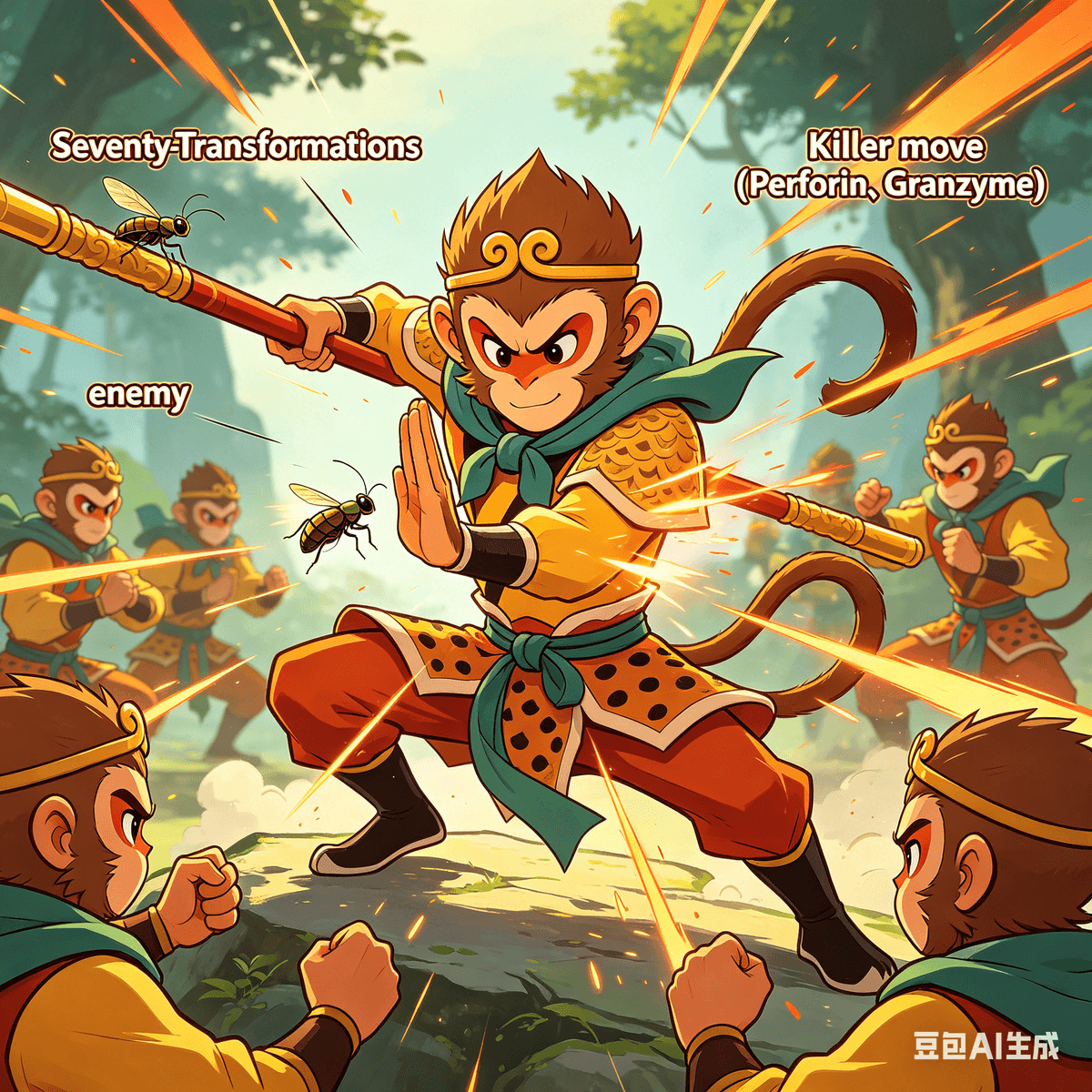
Episode 1: The Birth of the Stone Monkey & The Awakening of the CD8⁺ T Cell — The Growth of an Immune "Killer" On the Mountain of Flowers and Fruit in the Eastern Continent of Superior Body, the clouds and mist looked like a fairyland. At the mountain's peak stood a magic stone that had absorbed the essence of the sun and moon for thousands of years, glowing faintly with golden light like a fully charged battery. Suddenly, with a deafening thunderclap, the stone exploded. A streak of golden light shot into the sky. When the light faded, a stone monkey with a hairy, thunder-god-like face was left scratching his head, looking at the world in total confusion, much like a newborn baby waking up with no idea where he was. "Where is this place? Who am I?" The stone monkey skipped and leaped through the woods, grabbing wild fruits one moment and chasing wild hares the next. Seeing that this little guy had innate divine strength, jumping higher and lifting heavier than anyone else, the other apes gathered around, calling him "Great King" and directly pushing him onto the throne as the lord of the Mountain of Flowers and Fruit. As days passed, the stone monkey lived a carefree and comfortable life on the mountain, eating, drinking, and playing around. But the joy didn't last long before worries set in. One day, watching an old ape die of old age, he squatted on the ground, hung his head, and sighed: "We live so happily every day, but in the end, we still can't escape life and death. Is there no way to live forever?" A wrinkled old ape leaned in and whispered, "Your Majesty, I've heard there are fairy mountains across the sea where immortals live. Maybe they can teach you the art of immortality, so you'll never have to fear death again." The stone monkey's eyes immediately lit up. He slapped his thigh and decided: "Great! I'll cross the ocean right now to find the immortals and learn their skills!" Acting immediately, the stone monkey stuffed a few wild fruits into his pockets, hopped onto a wooden raft, and drifted out to sea. Along the way, he endured wind, sun, waves, and rain, nearly ending up as a shark's snack. Finally, he drifted to the Spirit Platform Heart Mountain and met the Patriarch Subhuti. The Patriarch sat perfectly on a lotus throne, his eyes piercing and bright—clearly no ordinary person. "You stone monkey, you have some spiritual roots. What path do you seek?" Patriarch Subhuti asked slowly, stroking his beard. The stone monkey dropped to his knees with a thud and said respectfully, "Your disciple wishes to learn the art of immortality to escape the cycle of life and death. Please guide me, Patriarch!" Subhuti smiled and waved his hand. "The immortality you seek isn't about your physical body never dying; it's about becoming the guardian of the 'Great Tang Empire' (our human body). Only by protecting the peace of the body can you achieve true immortality. I will teach you the 72 Transformations, so you can identify 'bad guys' (antigens) and adapt flexibly. I'll also teach you a set of 'killer moves' to help you shed your ignorance and become a true immune 'killer'." The stone monkey scratched his head, still not quite understanding. "Patriarch, what are 'bad guys'? And what's a guardian?"  "The 'bad guys' are the demons and monsters invading the 'Great Tang Empire'—they bully the common people (body cells) and cause destruction. And you must drive these 'bad guys' out to protect the safety of the people," Subhuti paused, his tone growing serious. "However, your temper is too impulsive. If you don't restrain yourself, you might accidentally hurt the common people. Let me tell you: in the future, if you meet a monk wearing a cassock and holding a monk's staff, he is your master. You must listen to him to achieve greatness." The stone monkey nodded, half-understanding, and muttered, "Disciple remembers. Find the master in a cassock, listen to the master!"  In the days that followed, the stone monkey trained day and night, mastering the 72 Transformations. He could turn into a tiny bug to eavesdrop on "enemy intel," create clones to surround enemies, and unleash invisible "killer moves" (perforin and granzymes) to strike vital points instantly. Watching him, Subhuti nodded secretly: "You have learned all you can. Go back to the Mountain of Flowers and Fruit. Remember, do not act recklessly, and wait patiently for your master to appear." Back at the Mountain of Flowers and Fruit, the stone monkey got arrogant, feeling invincible. He crashed the Dragon Palace of the Eastern Sea and forced the Dragon King to give him a treasure. The helpless Dragon King brought out the Ruyi Jingu Bang (Golden Cudgel). The stone monkey weighed it in his hands and grinned from ear to ear: "This treasure can shrink or grow—perfect for beating demons (antigens)!" After that, he strutted away. Later, he caused chaos in the Underworld, crossing out the names of all his apes in the Book of Life and Death, boasting, "My subjects will never fear death again!" But his reckless actions ultimately angered the Heavenly Court, and he was finally crushed under the Five Elements Mountain by Buddha. He was pinned there for 500 years. During those 500 years, the stone monkey reflected every day, remembering Subhuti's words, and growing increasingly confused: "Where is my master? Can I really become a guardian and fight demons properly?" Finally, one day, footsteps echoed at the foot of the mountain. The stone monkey looked up and saw a monk wearing a cassock and holding a staff slowly walking over. He had a gentle face and determined eyes—exactly the master Subhuti had described. The stone monkey immediately got excited and cried out for help: "Master! Master, save me!" The monk stopped, looking at the stone monkey under the mountain, his eyes full of compassion: "You stone monkey, how did you get trapped here?" "My name is Sun Wukong. I was trapped here for causing havoc in Heaven. Patriarch Subhuti said you are my master!" Sun Wukong said eagerly. "Master, I know I was wrong. I'll never cause trouble again. I want to take you as my master, follow you on your journey west, fight demons, and protect the 'Great Tang Empire'!" The monk smiled slightly; it was indeed Tang Sanzang. "Since you have a repentant heart, I will save you. But you must promise me: you will never recklessly hurt people again. You must distinguish who is a demon and who is a citizen, eliminate demons precisely, and not lose your temper." With that, Tang Sanzang removed the sealing talisman from the mountain top. The Five Elements Mountain collapsed with a boom, and Sun Wukong regained his freedom. He dropped to his knees to formally acknowledge his master: "Disciple Sun Wukong greets the Master!" Tang Sanzang helped him up and handed him a tightening headband: "Wear this. If you get impulsive and lose your temper in the future, I will chant the tightening spell to restrain you." Sun Wukong put it on without hesitation, secretly swearing to himself: I will definitely listen to my master and become a qualified immune guardian. Tang Sanzang looked into the distance, his tone gentle yet firm: "Wukong, our 'Great Tang Empire' (the body) is being invaded by a group of demons (antigens), and the people (cells) are suffering miserably. Our journey to the west is a journey to protect the 'Great Tang Empire.' Though the road ahead is perilous, as long as we work together, we can drive the demons out. Do you dare to come with me?" Sun Wukong gripped his Golden Cudgel tightly, his eyes full of determination. Patting his chest, he said, "Rest assured, Master! I, Old Sun, have vast magical powers. I will surely keep you safe and wipe out all the demons!"  The master and disciple walked side by side toward the west, bathed in sunlight. A journey of immune protection, full of joy and science, had officially begun.  (A little secret here: Sun Wukong didn't know it yet, but his core skill—lysing infected cells—is exactly what CD8⁺ T cells do in our immune system. It's only by following his master that he will truly understand his "job responsibilities"!)  The Immune System's Elite Assassin: Understanding CD8⁺ T Cells Imagine your body as a high-security kingdom, constantly under threat from invaders. While some enemies, like bacteria, might attack from the outside, others are much sneakier. Viruses, for example, don't just hang around in your bloodstream; they sneak inside your body's own cells, turning them into factories for new viruses. This is where the CD8⁺ T cell, our immune system's elite assassin, steps in. Think of CD8⁺ T cells as the Special Forces of your immune system. Their mission? To identify and eliminate your own body cells that have gone rogue—either because they've been infected by viruses or other intracellular pathogens, or because they've transformed into cancer cells. They don't attack the invaders themselves, but rather the infected cells that are harboring these threats. How They're Trained: Learning the "Bad Guys" Like any highly trained soldier, CD8⁺ T cells undergo rigorous training in a special organ called the thymus. Here, they learn a critical lesson: distinguish between "self" (your healthy body cells) and "non-self" (infected or cancerous cells). Each CD8⁺ T cell develops a unique "key" on its surface called a T cell receptor (TCR), designed to recognize a very specific "identification badge" displayed by cells. Healthy body cells constantly display fragments of their internal proteins on their surface using a special molecule called MHC Class I. This is like a cell routinely holding up an "I'm okay" sign. But when a cell gets infected by a virus, it starts making viral proteins. Fragments of these viral proteins are then also displayed on the cell's MHC Class I molecules. This acts as a distress signal—an "I'm infected!" badge. The Mission: Seeking and Identifying the Threat Our CD8⁺ T cells constantly patrol the body, scanning every cell they encounter. When a CD8⁺ T cell's specific TCR key matches the "infected" badge (viral protein fragment on MHC Class I) displayed by an unfortunate cell, it's a positive identification. This is the moment the assassin finds its target. The Action: Eliminating the Enemy Within Once a CD8⁺ T cell firmly latches onto an infected cell, it doesn't hesitate. It releases a barrage of potent "molecular grenades" and "punches." These include: •	Perforin: A protein that creates pores (holes) in the target cell's membrane, much like punching holes in a wall. •	Granzymes: Enzymes that slip through these pores and activate a self-destruct program within the infected cell, causing it to neatly dismantle itself without spilling its contents and spreading the infection. This process is incredibly precise and targeted. The CD8⁺ T cell doesn't cause widespread damage; it only kills the specific infected cell, leaving healthy neighbors untouched. After eliminating its target, the CD8⁺ T cell moves on to find another. The Memory: Learning from Experience After successfully fighting an infection, some CD8⁺ T cells transform into "memory T cells." These cells stick around for months, years, or even a lifetime. If the same invader ever attacks again, these memory cells can quickly multiply and launch an even faster, stronger response, often preventing you from even feeling sick. This is the basis of long-term immunity against many viral diseases. Why They Matter: Your Body's Internal Security CD8⁺ T cells are crucial for defending against viral infections (like the flu, measles, or even COVID-19), certain bacterial infections that hide inside cells, and importantly, for identifying and destroying cancerous cells before they can grow into full-blown tumors. They are the guardians that keep your internal environment safe and free from internal threats.  ________________________________________ Links for CD8⁺ T Cells (Cytotoxic T Lymphocytes) References 1.	Martínez-Lostao, L., et al. (2015). Perforin-mediated immune surveillance and cytolysis by CD8+ T cells. Trends in Immunology, 36(11), 664-674. •	Link: https://www.cell.com/trends/immunology/fulltext/S1471-4906(15)00216-9 (Abstract) 2.	Farber, D. L., et al. (2014). CD8 T cell memory: new developments and challenges. Nature Reviews Immunology, 14(1), 24-34. •	Link: https://www.nature.com/articles/nri3595 (Abstract) 3.	Kupz, A., & Farber, D. L. (2019). The CD8 T cell response to viral infection. Current Opinion in Virology, 36, 1-7. •	Link: https://www.sciencedirect.com/science/article/pii/S187962571930068X (Abstract) 4.	Blum, J. S., et al. (2013). The cell biology of MHC class I antigen presentation. Immunological Reviews, 251(1), 2-19. •	Link: https://onlinelibrary.wiley.com/doi/full/10.1111/imr.12026 (Abstract) 5.	Teixeiro, E., et al. (2015). CD8+ T cells: masters of adaptive immunity. Immunological Reviews, 267(1), 60-72. •	Link: https://onlinelibrary.wiley.com/doi/full/10.1111/imr.12321 (Abstract) 6.	Chen, D. S., & Mellman, I. (2013). Oncology meets immunology: the cancer-immunity cycle. Immunity, 39(1), 1-10. •	Link: https://www.cell.com/immunity/fulltext/S1074-7613(13)00282-3 (Abstract) 7.	Blank, C. U., et al. (2019). The cancer-immunity cycle and its therapeutic manipulation. Immunity, 50(5), 1109-1115. •	Link: https://www.cell.com/immunity/fulltext/S1074-7613(19)30172-2 (Abstract) 8.	Wherry, E. J., & Kurachi, M. (2015). Molecular and cellular insights into T cell exhaustion. Nature Reviews Immunology, 15(8), 486-499. •	Link: https://www.nature.com/articles/nri3862 (Abstract) 9.	Sallusto, F., et al. (2004). Central memory and effector memory T cell subsets: function, generation, and maintenance. Annual Review of Immunology, 22, 745-767. •	Link: https://www.annualreviews.org/doi/abs/10.1146/annurev.immunol.22.012703.104702 (Abstract) 10.	Curtsinger, J. M., & Mescher, M. F. (2010). Costimulation of naive CD8 T cells in vivo. Current Opinion in Immunology, 22(3), 323-328. •	Link: https://www.sciencedirect.com/science/article/pii/S095279151000083X (Abstract)

Science

The Immune System's Elite Assassin: Understanding CD8⁺ T Cells

Imagine your body as a high-security kingdom, constantly under threat from invaders. While some enemies, like bacteria, might attack from the outside, others are much sneakier. Viruses, for example, don't just hang around in your bloodstream; they sneak inside your body's own cells, turning them into factories for new viruses. This is where the CD8⁺ T cell, our immune system's elite assassin, steps in.

Think of CD8⁺ T cells as the Special Forces of your immune system. Their mission? To identify and eliminate your own body cells that have gone rogue—either because they've been infected by viruses or other intracellular pathogens, or because they've transformed into cancer cells. They don't attack the invaders themselves, but rather the infected cells that are harboring these threats.

How They're Trained: Learning the "Bad Guys" Like any highly trained soldier, CD8⁺ T cells undergo rigorous training in a special organ called the thymus. Here, they learn a critical lesson: distinguish between "self" (your healthy body cells) and "non-self" (infected or cancerous cells). Each CD8⁺ T cell develops a unique "key" on its surface called a T cell receptor (TCR), designed to recognize a very specific "identification badge" displayed by cells.

Healthy body cells constantly display fragments of their internal proteins on their surface using a special molecule called MHC Class I. This is like a cell routinely holding up an "I'm okay" sign. But when a cell gets infected by a virus, it starts making viral proteins. Fragments of these viral proteins are then also displayed on the cell's MHC Class I molecules. This acts as a distress signal—an "I'm infected!" badge.

The Mission: Seeking and Identifying the Threat Our CD8⁺ T cells constantly patrol the body, scanning every cell they encounter. When a CD8⁺ T cell's specific TCR key matches the "infected" badge (viral protein fragment on MHC Class I) displayed by an unfortunate cell, it's a positive identification. This is the moment the assassin finds its target.

The Action: Eliminating the Enemy Within Once a CD8⁺ T cell firmly latches onto an infected cell, it doesn't hesitate. It releases a barrage of potent "molecular grenades" and "punches." These include:

• Perforin: A protein that creates pores (holes) in the target cell's membrane, much like punching holes in a wall.

• Granzymes: Enzymes that slip through these pores and activate a self-destruct program within the infected cell, causing it to neatly dismantle itself without spilling its contents and spreading the infection.

This process is incredibly precise and targeted. The CD8⁺ T cell doesn't cause widespread damage; it only kills the specific infected cell, leaving healthy neighbors untouched. After eliminating its target, the CD8⁺ T cell moves on to find another.

The Memory: Learning from Experience After successfully fighting an infection, some CD8⁺ T cells transform into "memory T cells." These cells stick around for months, years, or even a lifetime. If the same invader ever attacks again, these memory cells can quickly multiply and launch an even faster, stronger response, often preventing you from even feeling sick. This is the basis of long-term immunity against many viral diseases.

Why They Matter: Your Body's Internal Security CD8⁺ T cells are crucial for defending against viral infections (like the flu, measles, or even COVID-19), certain bacterial infections that hide inside cells, and importantly, for identifying and destroying cancerous cells before they can grow into full-blown tumors. They are the guardians that keep your internal environment safe and free from internal threats.

Reference


inks for CD8⁺ T Cells (Cytotoxic T Lymphocytes) References

  1. Martínez-Lostao, L., et al. (2015). Perforin-mediated immune surveillance and cytolysis by CD8+ T cells. Trends in Immunology, 36(11), 664-674. Link: https://www.cell.com/trends/immunology/fulltext/S1471-4906(15)00216-9 (Abstract)
  2. Farber, D. L., et al. (2014). CD8 T cell memory: new developments and challenges. Nature Reviews Immunology, 14(1), 24-34. Link: https://www.nature.com/articles/nri3595 (Abstract)
  3. Kupz, A., & Farber, D. L. (2019). The CD8 T cell response to viral
    infection. Current Opinion in Virology, 36, 1-7. Link: https://www.sciencedirect.com/science/article/pii/S187962571930068X (Abstract)
  4. Blum, J. S., et al. (2013). The cell biology of MHC class I antigen
    presentation. Immunological Reviews, 251(1), 2-19. Link: https://onlinelibrary.wiley.com/doi/full/10.1111/imr.12026 (Abstract)
  5. Teixeiro, E., et al. (2015). CD8+ T cells: masters of adaptive immunity. Immunological Reviews, 267(1), 60-72. Link: https://onlinelibrary.wiley.com/doi/full/10.1111/imr.12321 (Abstract)
  6. Chen, D. S., & Mellman, I. (2013). Oncology meets immunology: the
    cancer-immunity cycle. Immunity, 39(1), 1-10. Link: https://www.cell.com/immunity/fulltext/S1074-7613(13)00282-3 (Abstract)
  7. Blank, C. U., et al. (2019). The cancer-immunity cycle and its therapeutic manipulation. Immunity, 50(5), 1109-1115. Link: https://www.cell.com/immunity/fulltext/S1074-7613(19)30172-2 (Abstract)
  8. Wherry, E. J., & Kurachi, M. (2015). Molecular and cellular insights into T
    cell exhaustion. Nature Reviews Immunology, 15(8), 486-499. Link: https://www.nature.com/articles/nri3862 (Abstract)
  9. Sallusto, F., et al. (2004). Central memory and effector memory T cell subsets:
    function, generation, and maintenance. Annual Review of Immunology, 22, 745-767. Link: https://www.annualreviews.org/doi/abs/10.1146/annurev.immunol.22.012703.104702 (Abstract)
  10. Curtsinger, J. M., & Mescher, M. F. (2010). Costimulation of naive CD8 T cells in
    vivo. Current Opinion in Immunology, 22(3), 323-328. Link: https://www.sciencedirect.com/science/article/pii/S095279151000083X (Abstract)


Previous
Eastern Philosophy(1): Zhuangzi’s "Empty Boat" Mentality ...
Next
 Return to site
Profile picture
Cancel
Cookie Use
We use cookies to improve browsing experience, security, and data collection. By accepting, you agree to the use of cookies for advertising and analytics. You can change your cookie settings at any time. Learn More
Accept all
Settings
Decline All
Cookie Settings
Necessary Cookies
These cookies enable core functionality such as security, network management, and accessibility. These cookies can’t be switched off.
Analytics Cookies
These cookies help us better understand how visitors interact with our website and help us discover errors.
Preferences Cookies
These cookies allow the website to remember choices you've made to provide enhanced functionality and personalization.
Save